
Working harder — but getting less back?
The problem isn’t just policy.
It’s how the system itself works.
When systems stop working, everything becomes harder.
This is not a single failure — it is systemic.
Backbone Conservatism is a different way of approaching how government works.
It focuses on how systems are built, how they operate, and how they improve over time.
Judging goverance by what it produces.
How government should actually work
Backbone Conservatism focuses on how systems actually function in practice.
The goal is simple: systems that actually work in the real world.
Not intentions. Not promises. Results.
This is achieved through a system called Productive Governance.
People are working harder and getting less in return.
Systems are slow, confusing, and difficult to navigate.
Decisions are made, but things don’t get better.
The problem isn’t just policy.
It’s how the system itself is designed.
Why things aren’t improving
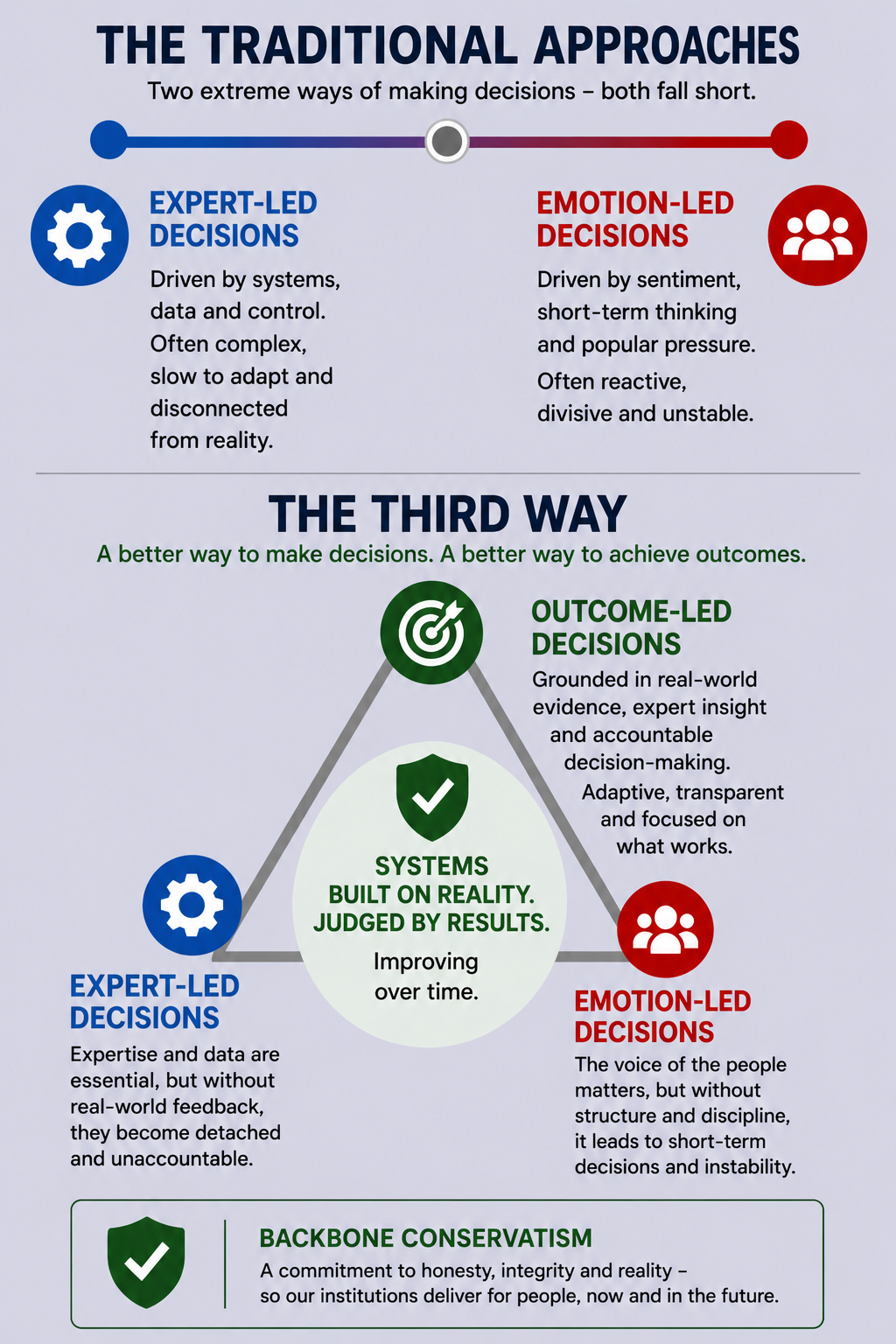
Moving beyond the false choice
Politics is often framed as a choice between competing approaches.
Expert-led systems prioritise process, data, and control — but often lose sight of real-world outcomes.
Populist approaches react quickly to public pressure — but rarely build systems that last.
Backbone Conservatism works differently:
Decisions are judged by what they actually produce.
Systems grounded in reality.
Judged by outcomes.
Improving over time.
What would actually change?
Faster decisions
Less delay. More gets done.
Simpler systems
Easier to understand. Easier to use.
Clearer accountability
It is clear how decisions are made — and who is responsible.
Better outcomes
Policies are judged by what they actually deliver — and changed if they don’t.
Not every change will be perfect, but each is designed to move outcomes in the right direction.
Why this matters
When systems work properly, people feel the difference.
Systems become easier to navigate.
Effort leads to real results.
Decisions make sense — and improve outcomes.
Over time, this builds a stronger, more stable society.
Where to go next
Start with the basics, or explore in more detail.